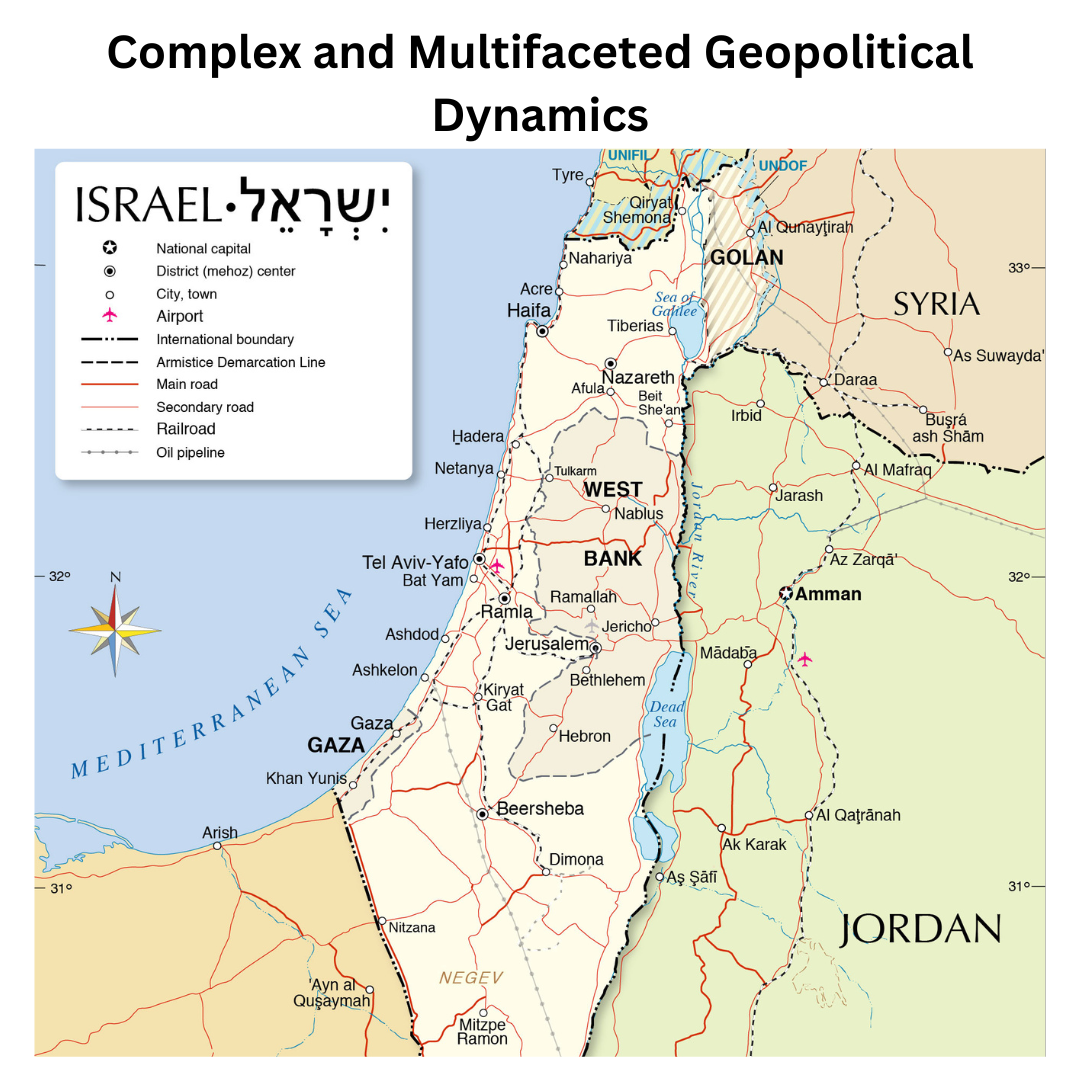
The Israel history is a complex and multifaceted narrative, filled with significant events, people, and geopolitical dynamics. In a brief overview, I’ll provide a condensed history of Israel, touching on key milestones, from ancient times to the modern state of Israel. READ MORE
Ancient History:
he history of the land now known as Israel stretches back thousands of years. The region has been inhabited by various peoples, including Canaanites, Egyptians, and Philistines, and has seen the rise and fall of many empires. The Hebrew Bible, also known as the Old Testament, tells the story of the Israelites and their conquest of Canaan, which they believed was promised to them by God. Under the leadership of figures like Abraham, Moses, and King David, the Israelites established a kingdom with its capital in Jerusalem. However, this kingdom later split into the northern Kingdom of Israel and the southern Kingdom of Judah.
Babylonian Exile and Return:
The Babylonians conquered Jerusalem in 586 BCE, leading to the Babylonian Exile when the Jewish people were forcibly removed from their land and taken to Babylon. This period played a significant role in shaping the Jewish identity and religious traditions. In 539 BCE, the Persians, led by King Cyrus the Great, captured Babylon and allowed the Jews to return to their homeland. This marked the beginning of the Second Temple period.
Greek and Roman Rule:
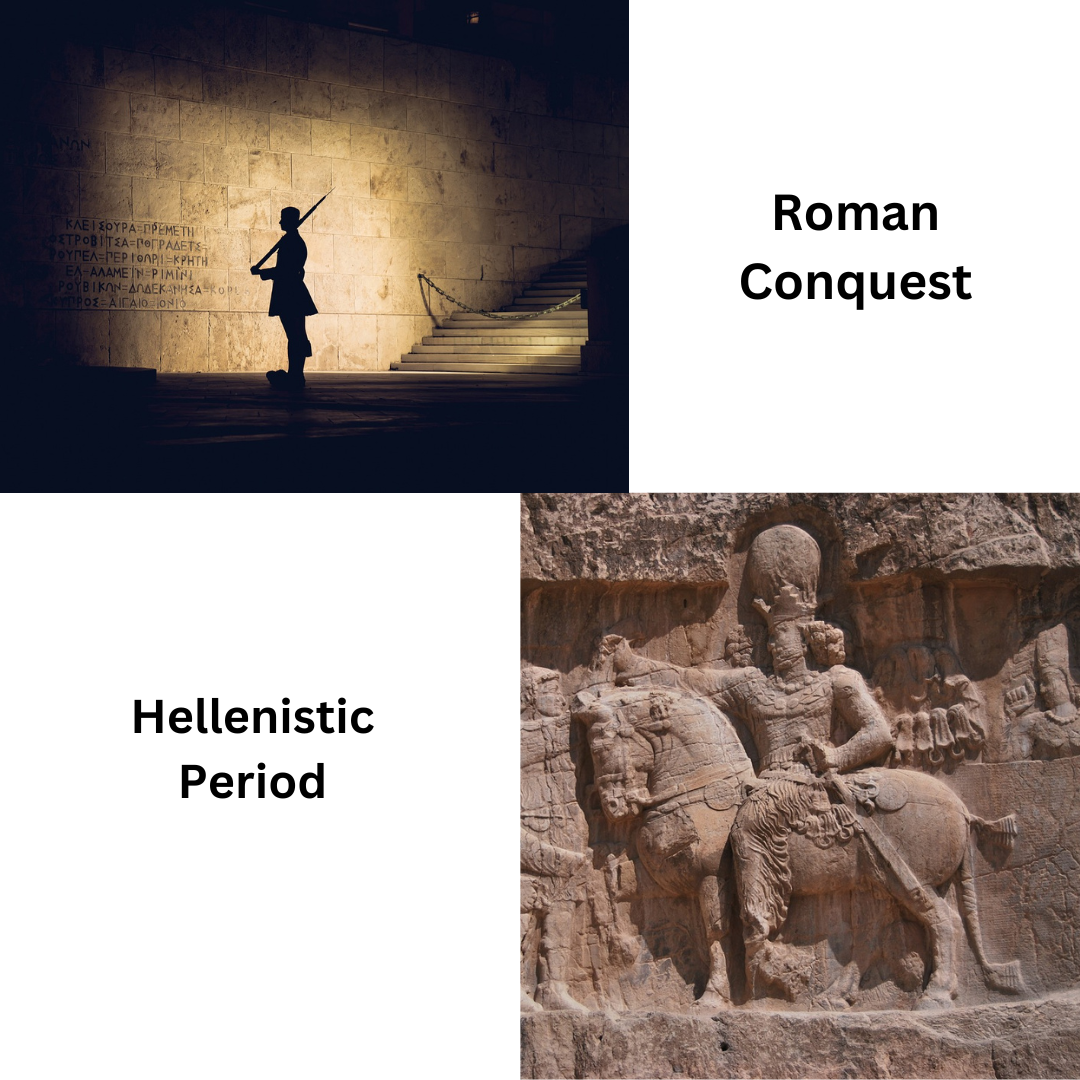
Following the conquest of Alexander the Great, the region came under Hellenistic influence. Later, it became part of the Roman Empire. During this time, Jerusalem was the site of the construction of the Second Temple, which became a central religious and cultural institution for the Jewish people. In 70 CE, the Romans destroyed the Second Temple in response to a Jewish revolt, leading to the dispersal of Jews throughout the Roman Empire, known as the Jewish Diaspora.
Greek and Roman rule in the region now known as Israel was a significant period in its history. Here’s a concise overview of the Greek and Roman influence in this area:
Greek Rule in Israel History:
1. Hellenistic Period: After the conquests of Alexander the Great in the 4th century BCE, the eastern Mediterranean, including the region of Israel, fell under Hellenistic influence. Alexander’s successors, the Diadochi, divided his empire, and the land of Israel became part of the Seleucid Empire.
2. Hellenistic Culture: During the Hellenistic period, Greek culture, language, and traditions began to permeate the region. Greek became the language of administration and communication, and Greek-style cities, such as Antioch, were established.
3. Revolts and Maccabean Revolt: The imposition of Hellenistic religious and cultural practices, particularly the desecration of the Jewish Temple in Jerusalem, led to revolts. The Maccabean Revolt (167-160 BCE) resulted in the establishment of an independent Jewish state for a brief period.
Roman Rule in Israel History:
1. Roman Conquest: In 63 BCE, the Roman general Pompey the Great conquered Jerusalem, marking the beginning of Roman rule in the region. While the Romans allowed local rulers to govern, they retained significant influence.
2. Herod the Great: King Herod the Great, a client of the Roman Empire, played a key role in the region during the 1st century BCE. He undertook ambitious building projects, including the expansion and renovation of the Second Temple in Jerusalem.
3. Birth of Christianity: The Roman province of Judaea became the backdrop for the life of Jesus of Nazareth, the founder of Christianity. The crucifixion of Jesus occurred during Roman rule.
4. Great Jewish Revolt: In 66 CE, a major Jewish revolt against Roman rule erupted, leading to the destruction of the Second Temple in 70 CE by the Roman general Titus. This event had a profound impact on Judaism.
5. Bar Kokhba Revolt: A second Jewish revolt, known as the Bar Kokhba Revolt (132-136 CE), was brutally suppressed by the Romans. Following this revolt, Jerusalem was renamed Aelia Capitolina, and Jews were largely excluded from the city.
6. Byzantine Transition: The region was later incorporated into the Eastern Roman (Byzantine) Empire, and Christianity became the dominant religion. Byzantine rule persisted until the Islamic conquest in the 7th century.
The Greek and Roman periods in the history of Israel marked significant cultural and religious changes. Greek Hellenistic influences, followed by Roman rule, laid the foundation for subsequent developments, including the emergence of Christianity and its spread throughout the Roman Empire.
Byzantine, Islamic, and Crusader Periods:
The region went through various rulers and empires, including the Byzantine Empire, which adopted Christianity as the official religion, and then the Islamic Caliphates. Jerusalem, a holy city for both Jews and Christians, gained significance in Islam as well. During the medieval period, the region saw the Crusades, a series of religious wars, in which Jerusalem changed hands several times between Christians and Muslims.
Ottoman Rule:
For centuries, the region was part of the Ottoman Empire. During this time, Jewish communities were present in the area but often faced restrictions and discrimination. In the late 19th and early 20th centuries, the Zionist movement, advocating for the establishment of a Jewish homeland in Palestine, gained momentum.
British Mandate:
After World War I, the League of Nations granted Britain a mandate to administer the territory, then known as Palestine. The British Mandate, which lasted from 1920 to 1948, was marked by tensions between Jewish immigrants and the Arab population.
Founding of the State of Israel:
Following World War II and the horrors of the Holocaust, there was widespread international support for the establishment of a Jewish homeland. In 1947, the United Nations approved the partition of Palestine into separate Jewish and Arab states, along with an international administration for Jerusalem. On May 14, 1948, David Ben-Gurion declared the establishment of the State of Israel. This led to the Arab-Israeli War of 1948-1949.
The founding of the State of Israel is a pivotal event in the history of the Middle East and the Jewish people. It culminated in the establishment of a Jewish homeland in the region known as Palestine. Here is an overview of the key events leading to the founding of the State of Israel:
Background:
- Late 19th and Early 20th Century: During the late 19th and early 20th centuries, a movement known as Zionism gained momentum. Zionism aimed to establish a national homeland for the Jewish people in the historical region of Palestine, which was part of the Ottoman Empire at the time. Theodor Herzl, a prominent Zionist leader, played a central role in advocating for this cause.
- World War I and the Balfour Declaration: During World War I, the Ottoman Empire was aligned with the Central Powers, while the United Kingdom and its allies were fighting against them. In 1917, the British government issued the Balfour Declaration, which expressed support for the establishment of a “national home for the Jewish people” in Palestine.
British Mandate (1920-1948):
- League of Nations Mandate: After World War I, the League of Nations granted Britain a mandate to administer the territory of Palestine, including the region that would become Israel. The mandate began in 1920 and was intended to facilitate the establishment of a national home for the Jewish people.
- Immigration and Tensions: The British Mandate period was marked by tensions between Jewish immigrants and the Arab population. Jewish immigration to Palestine increased significantly during this time, which led to concerns among the Arab population about land and political rights.
- Arab Revolts: The Arab population in Palestine engaged in a series of revolts against both British rule and Jewish immigration. The Great Arab Revolt of 1936-1939 had a significant impact on the region, resulting in restrictions on Jewish immigration and land purchases.
The United Nations Partition Plan (1947):
- UN Resolution 181: In 1947, the United Nations passed Resolution 181, known as the UN Partition Plan for Palestine. It recommended the partition of Palestine into separate Jewish and Arab states, with Jerusalem placed under international administration. The plan was accepted by the Jewish leadership but rejected by Arab states and Palestinian Arab leaders.
Declaration of the State of Israel (1948):
- May 14, 1948: On May 14, 1948, David Ben-Gurion, the head of the Jewish Agency, declared the establishment of the State of Israel. This declaration came on the eve of the expiration of the British Mandate.
- Arab-Israeli War: The declaration of Israel led to the Arab-Israeli War, also known as the 1948 Arab-Israeli War or the War of Independence. Several neighboring Arab states, including Egypt, Jordan, Syria, and Iraq, intervened in the conflict. The war lasted until 1949.
Aftermath:
- Armistice Agreements: Armistice agreements were reached between Israel and its neighboring states, resulting in de facto borders. These borders are often referred to as the “Green Line.”
- Displacement of Palestinian Arabs: The war also led to the displacement of a significant number of Palestinian Arabs, many of whom became refugees.
- Recognition and Statehood: Over time, Israel gained international recognition and established diplomatic relations with numerous countries.
The founding of the State of Israel was a historic moment for the Jewish people, fulfilling a long-held aspiration for a national homeland. However, it also marked the beginning of a complex and ongoing conflict between Israel and its Arab neighbors, particularly the Palestinians, over issues related to territory, refugees, and national identity. The consequences of this conflict continue to shape the region’s geopolitics and international relations today.
Early Conflicts and Expansion:
The new state of Israel faced immediate challenges, including wars with neighboring Arab countries, which sought to prevent its establishment. The 1956 Suez Crisis and the 1967 Six-Day War further shaped the political landscape and territorial boundaries. Israel gained control of the West Bank, East Jerusalem, Gaza Strip, and the Golan Heights in the aftermath of the 1967 war.
Peace Processes and Conflict:
Efforts to achieve peace in the region have been ongoing for decades. The 1978 Camp David Accords and the 1993 Oslo Accords aimed to address the Israeli-Palestinian conflict, but progress has been slow and marred by violence. The First Intifada (1987-1993) and the Second Intifada (2000-2005) were significant uprisings in the Palestinian territories, leading to increased tensions.
Peace Agreements:
In 1979, Egypt became the first Arab country to formally recognize Israel, signing a peace treaty. In 1994, Jordan followed suit. More recently, the Abraham Accords, brokered by the United States, have seen several Arab nations, including the United Arab Emirates, Bahrain, and Morocco, establish diplomatic relations with Israel.
Settlements and the Palestinian Territories:
One of the most contentious issues in the Israeli-Palestinian conflict is the establishment of Israeli settlements in the West Bank, which has led to disputes over land and borders. The status of East Jerusalem and its importance to both Israelis and Palestinians remains a central point of contention.
The term “Palestinian Territories” refers to the areas in the Middle East that are home to Palestinian communities and governed by the Palestinian Authority. These territories include the West Bank, the Gaza Strip, and East Jerusalem. Here’s an overview of each of these regions:
1. West Bank in Israel History :
- The West Bank is a landlocked territory located to the west of the Jordan River. It is bordered by Israel to the west, north, and east, and by Jordan to the east. The West Bank is a significant part of historical Palestine and is home to a large Palestinian population.
- After the 1967 Six-Day War, Israel occupied the West Bank. It remains a contentious issue in the Israeli-Palestinian conflict.
- In 1993, the Oslo Accords led to limited Palestinian self-rule in parts of the West Bank under the Palestinian Authority (PA), though Israel maintains control over security in many areas. The situation is characterized by checkpoints, settlements, and ongoing tensions.
2. Gaza Strip in Israel History :
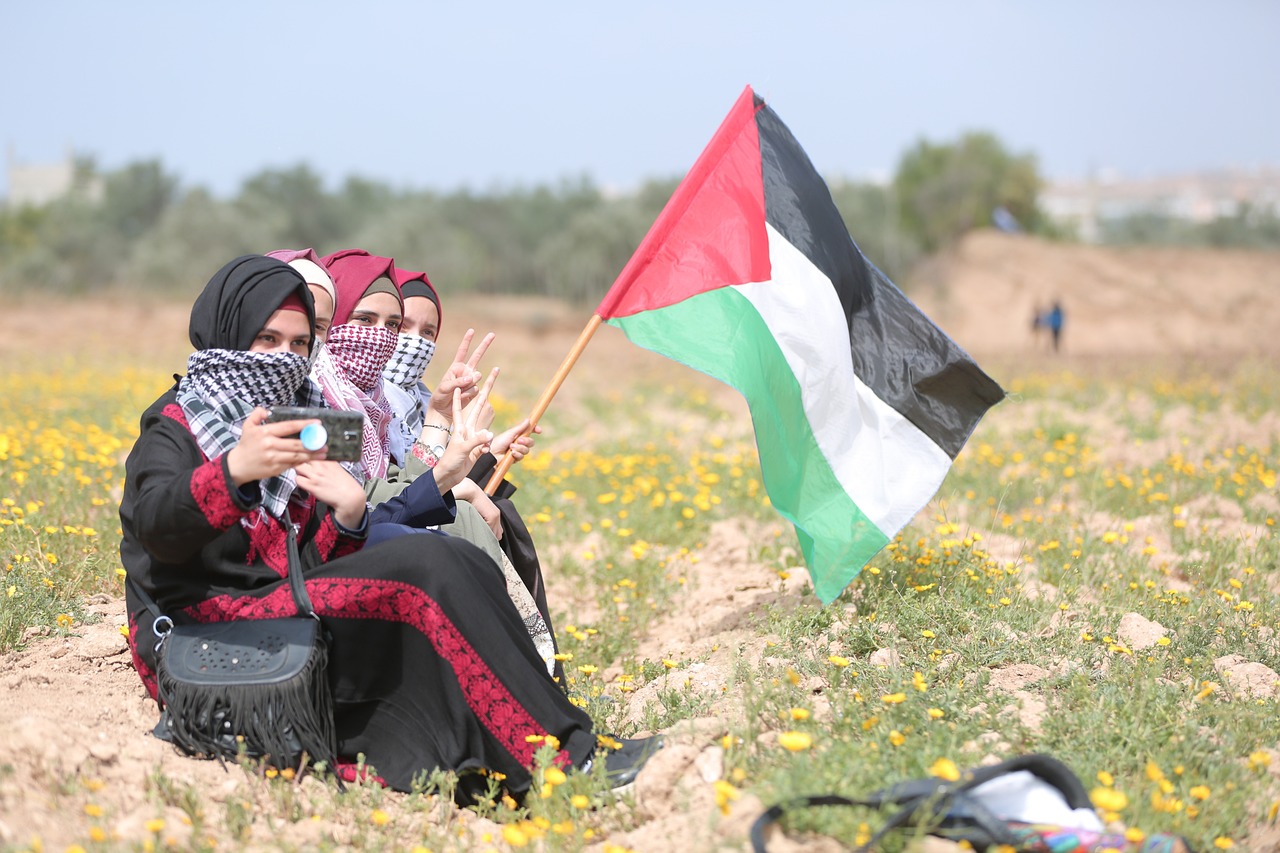
- The Gaza Strip is a narrow coastal territory on the eastern Mediterranean Sea, bordered by Israel to the north and east, and Egypt to the south. It is home to a dense Palestinian population.
- In 2005, Israel unilaterally withdrew its troops and settlers from the Gaza Strip. However, Israel still controls access to Gaza by land, sea, and air, and Egypt controls the southern border.
- Since 2007, the Gaza Strip has been governed by the Palestinian political and militant organization Hamas, following a conflict with the Palestinian Authority. The territory has been subject to an Israeli blockade, and it has experienced several conflicts, including the 2008-2009 Gaza War, the 2012 conflict, and the 2014 Israel-Gaza conflict.
3. East Jerusalem in Israel History:
- East Jerusalem is the eastern part of the city of Jerusalem and is considered by the international community as part of the Palestinian Territories. It was captured by Israel during the 1967 Six-Day War and subsequently annexed, a move not recognized by the international community.
- East Jerusalem is home to a significant Palestinian population, and it holds religious and historical significance for both Palestinians and Israelis.
- The status of East Jerusalem is a central and contentious issue in the Israeli-Palestinian conflict, particularly regarding the future of the city as a potential capital for both Israel and a future Palestinian state.
The Palestinian Territories have been at the heart of the Israeli-Palestinian conflict for many decades. The conflict involves complex political, territorial, and security issues, including disputes over borders, the status of refugees, and the quest for Palestinian self-determination. International efforts, negotiations, and peace processes have been ongoing to find a lasting resolution to the conflict, but a comprehensive and enduring peace agreement has proven elusive to date. The situation in the Palestinian Territories continues to be a major issue in regional and global geopolitics.
Modern Israel:
Modern Israel is a dynamic and diverse country in the Middle East with a complex history and a unique cultural and political landscape. Here’s an overview of modern Israel:

- Establishment of the State of Israel:
– The modern State of Israel was declared on May 14, 1948, in Tel Aviv by David Ben-Gurion, the head of the Jewish Agency. This declaration came on the eve of the expiration of the British Mandate for Palestine. It followed decades of Zionist efforts to establish a Jewish homeland in the historical region of Palestine.
- Early Years:
– The founding of Israel led to a war with neighboring Arab states. After a series of armistice agreements, Israel’s borders were established along the “Green Line,” which marked the de facto borders at the time.
– Israel absorbed a significant influx of Jewish immigrants, including survivors of the Holocaust. The young nation faced numerous challenges, including building infrastructure, providing for the needs of its population, and developing a national identity.
- Arab-Israeli Conflict:
– The Arab-Israeli conflict has been a defining aspect of modern Israel’s history. The conflict involves disputes over territory, refugees, and national identity and has led to a series of wars, uprisings, and peace efforts.
- Economic and Technological Development:
– Over the years, Israel has experienced impressive economic growth and technological advancement. The country has a thriving tech sector and is often referred to as the “Start-Up Nation” for its innovation in fields such as cybersecurity, biotechnology, and artificial intelligence.
- Society and Culture:
– Israel is a diverse society with a mix of Jewish, Arab, and other ethnic and religious communities. Hebrew is the official language, and Arabic is also widely spoken.
– The country is known for its vibrant cultural scene, with a rich heritage of literature, music, and art.
– Religious traditions and institutions hold a central place in Israeli society. Jerusalem, a city holy to Jews, Christians, and Muslims, is of great religious significance.
- Political Landscape:
– Israel is a parliamentary democracy with a multi-party system. The Knesset, the Israeli parliament, is the legislative body, and the country has a president as the head of state.
– Israel has faced political challenges, including issues related to the Israeli-Palestinian conflict, national security, and relations with neighboring countries.
- Peace Agreements:
– Israel signed peace agreements with Egypt in 1979 and Jordan in 1994, leading to diplomatic relations and cooperation between these countries.
– In recent years, Israel established diplomatic relations with several Arab states, including the United Arab Emirates, Bahrain, and Morocco, through the Abraham Accords.
- Geopolitical Context:
– Israel’s location in the Middle East places it at the center of regional geopolitical dynamics. The Israeli-Palestinian conflict, tensions with Iran, and broader regional dynamics have a significant impact on Israel’s security and foreign policy.
- Challenges and Prospects:
– Modern Israel continues to face challenges, including security concerns, the Israeli-Palestinian conflict, and internal political divisions.
– The country remains an important player in regional and global politics, with a complex relationship with the international community.
Modern Israel is a nation with a complex history, marked by both remarkable achievements and ongoing challenges. Its future is deeply intertwined with the pursuit of peace in the region and the resolution of longstanding conflicts.
Today, Israel is a vibrant and diverse nation with a strong economy, a dynamic cultural scene, and a thriving technological sector. However, the Israeli-Palestinian conflict continues to be a source of tension and violence, with ongoing efforts to find a lasting resolution. Israel’s identity as a Jewish state, its relationship with its Arab citizens, and its regional alliances and conflicts are central issues in its modern history.
3 thoughts on ““From Ancient History to the Modern State: Israel history in Brief””